These records are found in the online catalog of The Mariners’ Museum and Park in Newport News, Virginia. Uncurated search results are presented to give researchers and interested readers an idea of whether the museum’s archives contain information about this vessel and whether it may be worthwhile to visit the museum’s catalog search page for further investigation. Uncurated results may be inaccurate or incomplete.
Mariners Museum online catalog search, July 12, 2026. Search phrase: "Robbins". Catalog returned 43 records; this selection table includes 43 records fetched through catalog result pages.
Use these buttons to send uncurated search results to your own app or text document for further research. First, check the box for any row, or click "Select All" then uncheck any rows. Then click "Show Selections". You can then copy your selections from the text box and past them into your app.
L6323 - Maj. Robbins and Lt. Col. G. W. Porter of AG633. 1-20-44 Official Photograph, U. S. Army Signal Corps, HRPE, Newport News, Va. "SECRET Authority WD Cir 346 October 15, 1942 Initials WCS Date 31 JAN 1944" stamped in red ink.
Embarkation (Military science).
Maj. Robbins and Lt. Col. Porter stand together in a warehouse, ready to embark. Behind them, somewhat in shadow, is a mass of other young men waiting to embark. The 8 x 10 inscritpion reads "Lt. Col. G. W. Porter, 0-369943, Morgantown, West Virginia (left), CO of unit AG633-A (Casual Detachment of Air Corps Fillers) on pier 4 preparing to embark on HR 854, is her shown with Major G. B. Robbins, 0-398933, Clinton, N. Y."
NOTES: LP 200- LP 225 are part of a set of lithographs in colors on wove paper by Frederic Schiller Cozzens (American, 1846-1928). ADDITIONAL INFORMATION: See Kelley, J.D.Jerrold, "American Yachts", Chapter l and pg. 422. See also "The Old Print Shop Portfolio", Vol. I, No. 9, May 1942.
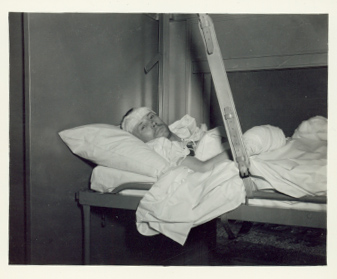
"Pvt. Hardie Robbins of San Francisco, Calif. who was severely burned during the opening stages of the invasion of North Africa, returned to the United States for Medical care. Photo was taken on a hospital train, Hampton Roads Port of Embarkation, Newport News, Va. 11-25-42 Official photograph USArmy Signal Corps HRPE Newport News, Va."; stamped in black "Confidential"
Hospital trains–Virginia–Newport News.; War–Relief of sick and wounded.; Burns and scalds–Virginia–Newport News.
Private Hardie Robbins laying down on a bunk bed aboard a hospital train.
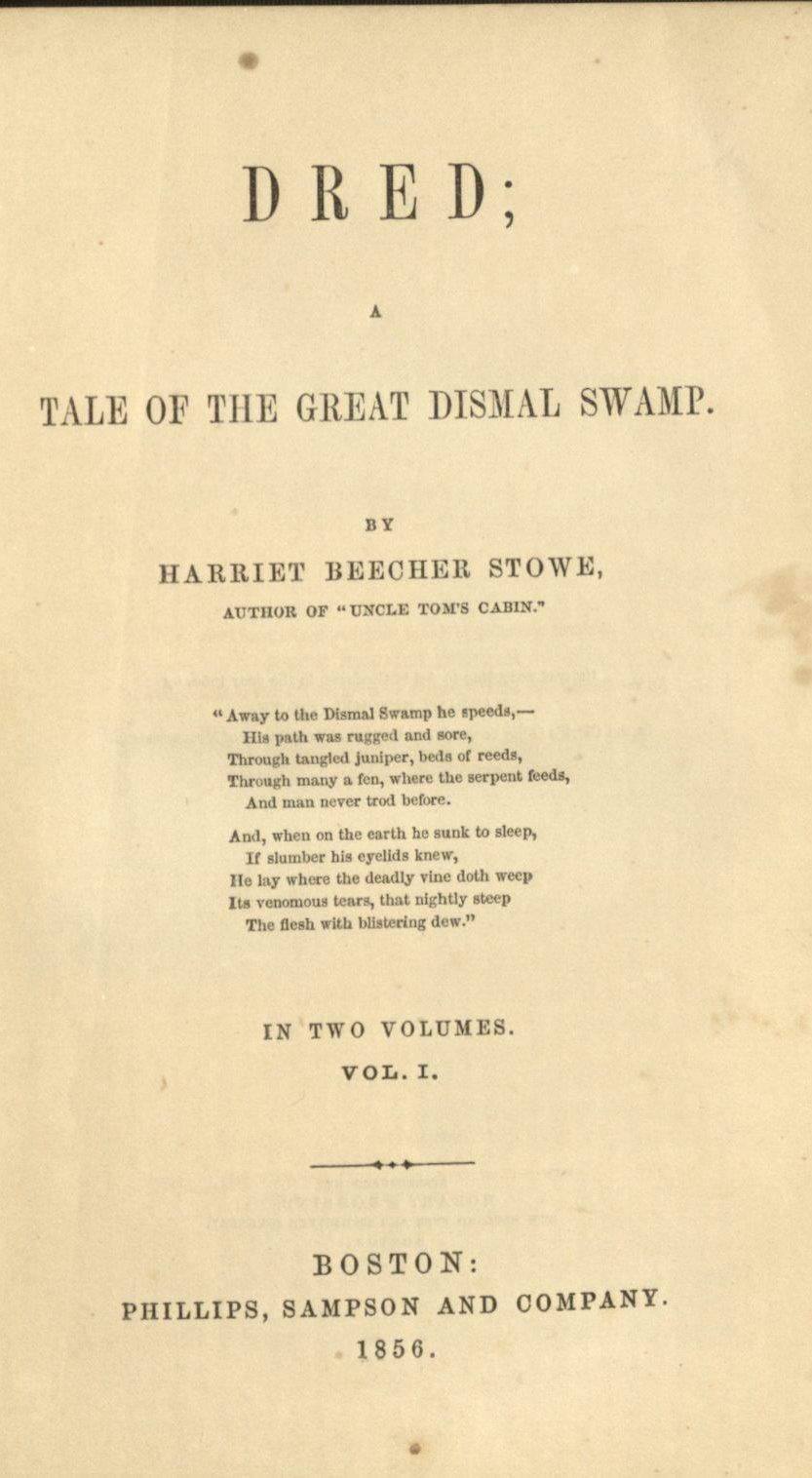
Robbins' journal : - comprising an account of the loss of the brig Commerce, of Hartford (Con.) James Riley, master, upon the western coast of Africa ..
Bound in volume: Discourses before the Humane Society of the Commonwealth of Massachusetts, 1787-1817.
Drowning–Resuscitation.; Lifesaving–Massachusetts; Merchant mariners–Missions and charities–United States.
A discourse delivered before the Humane Society of the Commonwealth of Massachusetts, at their semiannual meeting, June 14th, 1776 - by Chandler Robbins
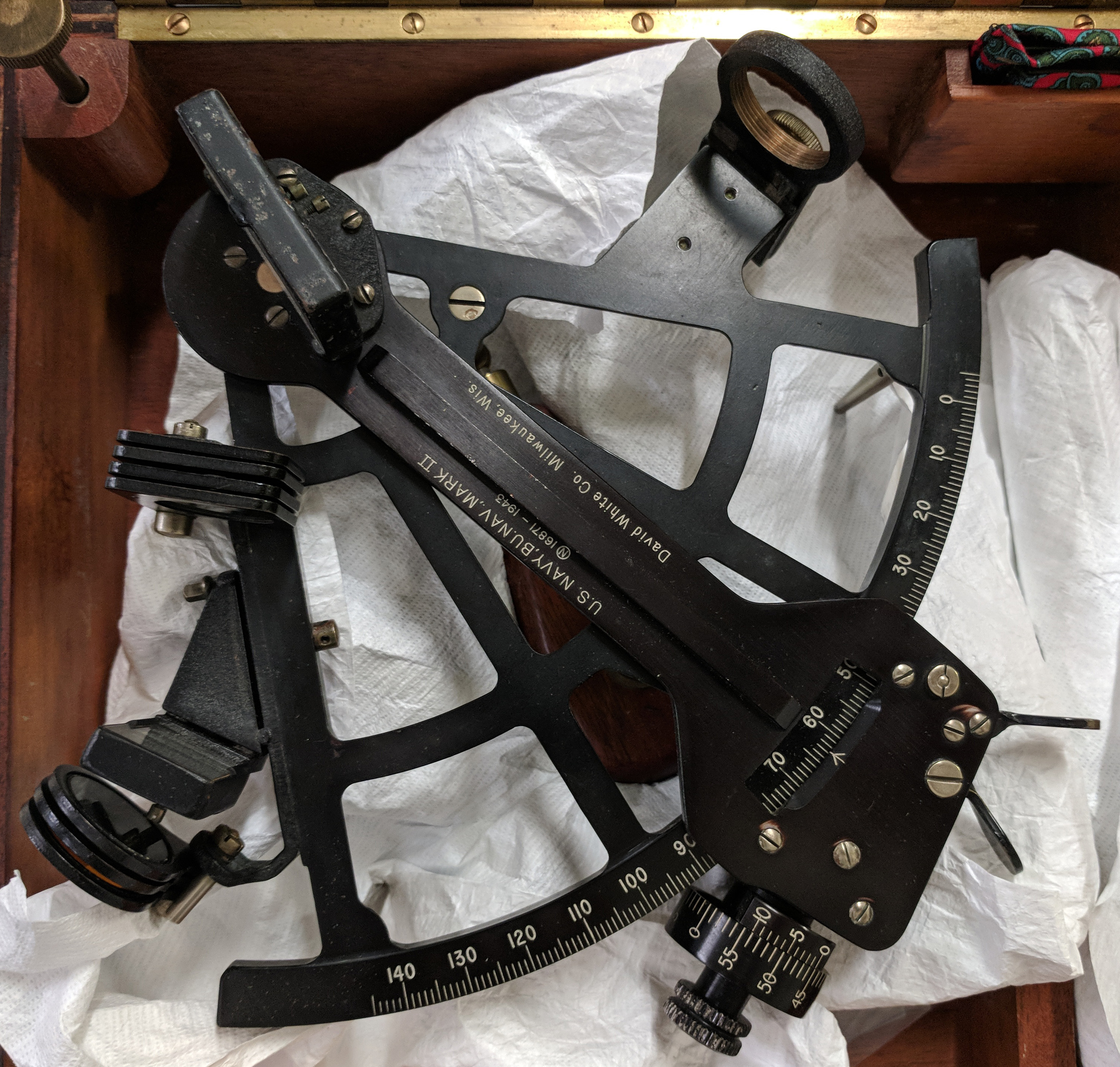
SHORT DESCRIPTION: United States Navy Mark II sextant, No. 16871, made by David WHITE Co, Milwaukee, Wisconsin dated 1943, in its original wooden box. Graduation -5°-145° (usable to 145°) in 1°. Vernier 0’-60’ & 0’-10’ in 1’. Four shades (green & red) and Three horizon glasses (red). The box contains a terrestrial telescope, a spare mirror, two screwdrivers. and a U.S. Naval Observatory certificate of eccentricity. EVENT: WORLD WAR II. TIME-SPACE: 1943-1948.
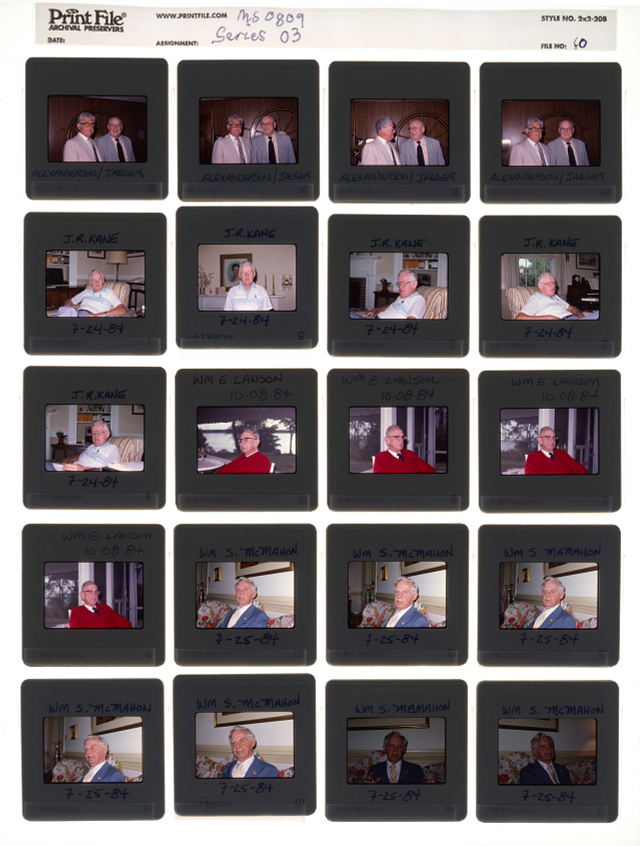
Interviewer is not known. John R. Kane served 38 years at Newport News Shipbuilding, starting in 1936 as a draftsman and retiring as the Director of Engineering, responsible for 2,600 engineering and design personnel. Title devised by Library staff.
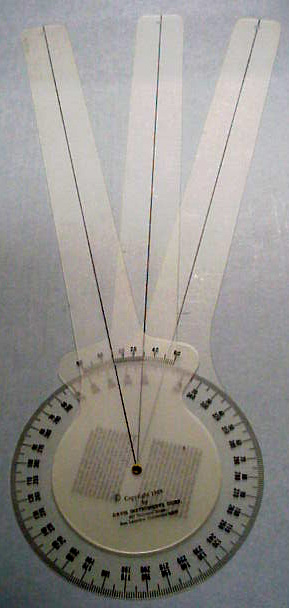
SHORT DESCRIPTION: Circular ‘CA-9 compass course arm protractor’, made by DAVIS Instruments Corporation of San Leandro, California, in its original plastic bag. Graduation 0°-360° v.v., in 1°. TIME-SPACE: 1965-1980.
SHORT DESCRIPTION: Silver inspector badge for the Bureau of Marine Inspection and Navigation. Inspector number 515. The badge is shield shaped with a smaller shield at the top. The shield at the top is divided with areas of stars and stripes and the letters U.S. The bottom of the larger shield has the text 'Marine Inspector and Navigation' and the number 515. The center of the shield has a port broadside view of a two masted paddlewheel steamer. NOTES: The Bureau of Marine Inspection and Navigation was merged with the Coast Guard in 1942. NOTES: These badges were worn by inspectors of the Bureau of Marine Inspection and Navigation, a long-established agency of the Commerce Department. The Bureau was merged with the Coast Guard in 1942. The bureau's duties, now part of the Coast Guard's merchant marine safety program, included: 1) Inspection and regulation fo vessels and equipment for physical protection of crew, passengers, and cargo., 2) Regulation of marine personnel and protection of their rights., 3) Engineering and technical supervision over safety standards., 4) Investigation and review of marine casualties and acts of incompetency or misconduct., 5) Liason with the maritime industry and international bodies.
United States–History–Naval operations–Civil War, 1861-1865–Juvenile fiction.; United States–History–Naval operations, Confederate–Civil War, 1861-1865–Juvenile fiction.
Cabin boys–Confederate States of America–Juvenile fiction.
Eben Tyne, powdermonkey - Patricia Beatty and Phillip Robbins
857 THORNTON - SAN LEANDRO - CALIFORNIA - UNITED STATES - Maker
SHORT DESCRIPTION: Assembly kit for a horizontal reflecting type artificial horizon, made by DAVIS Instruments Corporation of San Leandro, California, in case. Triangular box with two transparent sides and dark reflecting bottom. Can only be used to observe the sun. With printed instructions for assembly and use in the case. TIME-SPACE: 1970-1980.
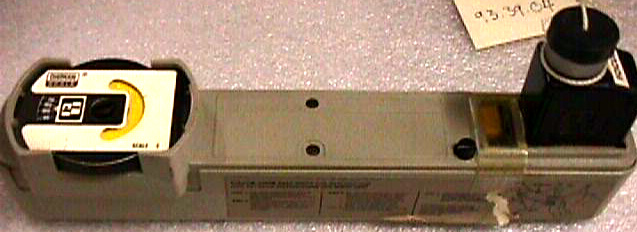
SHORT DESCRIPTION: Range finder, "Rangematic", made by RANGING Inc. of Rochester, N.Y., 700-07-8796 [this number may have been applied by donor]. Ranges from 50-1000 meters. Fitted with ‘scale 3’. Brief instructions stuck to the side. Apparently there were more scales, probably in the original box, which is missing. TIME-SPACE: 1960-1985. ADDITIONAL INFORMATION: SEE COLLECTION FILE.
GERMANY - Manufacturer; PLYMOUTH - MASSACHUSETTS - UNITED STATES - Related Place
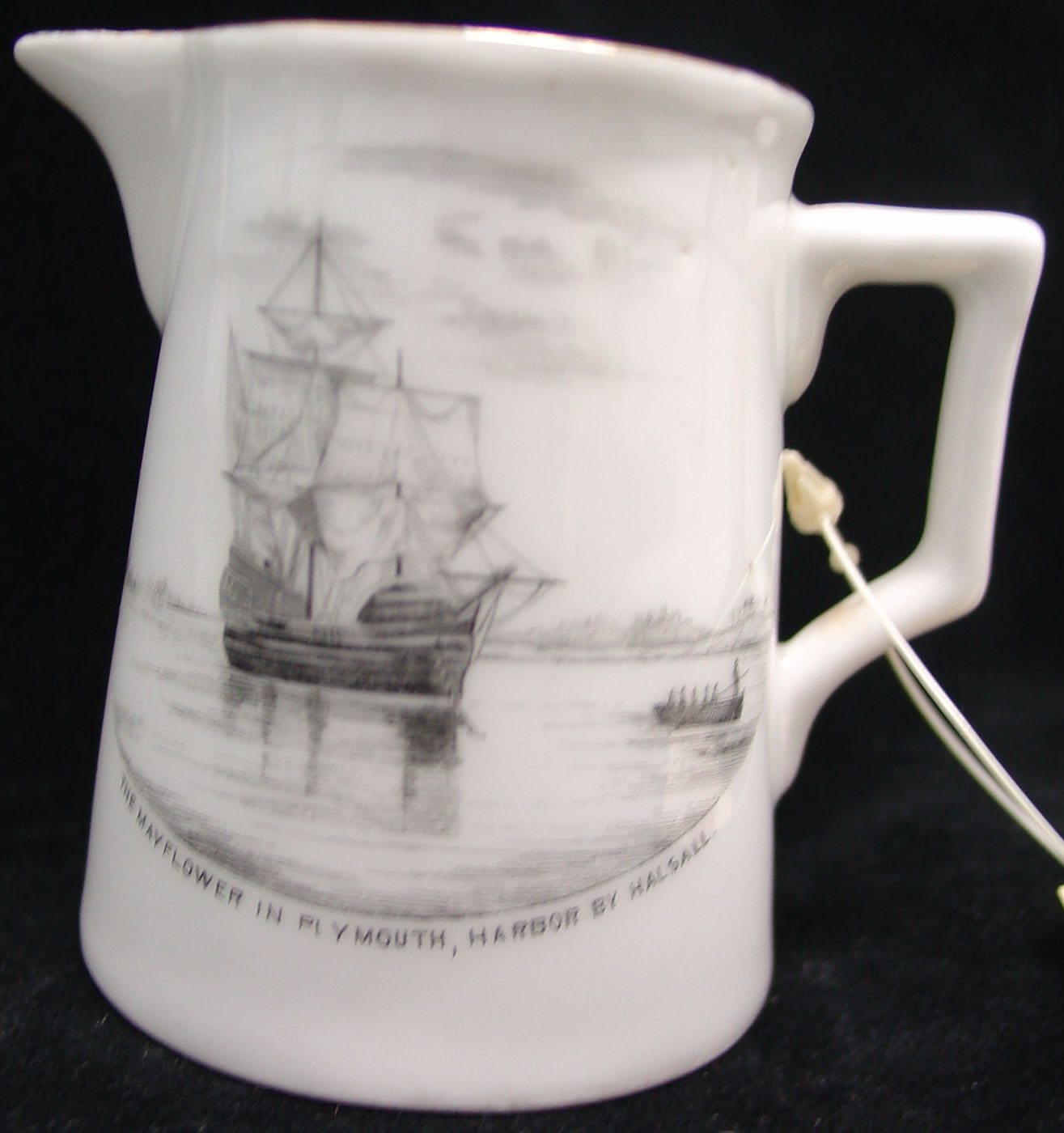
SHORT DESCRIPTON: Single handled ceramic cream pitcher with a caravel at anchor with a small boat ahead of it. An inscription is beneath the print. NOTES: William Formby Halsall paintined 'The Mayflower in Plymouth Harbor' in 1882.
Caption title. At head of title: United States Patent Office. Negative photocopy. "No. 902,452, specification of letters patent, patented Oct. 27, 1908, application filed February 10, 1908, serial no. 415, 202."
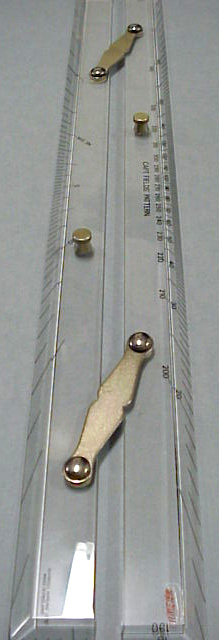
SHORT DESCRIPTION: Captain Fields’ Pattern parallel rule, made by BLUNDELL HARLING Ltd, England, in its original cardbord box. Portland series Cat. no. 0651.07, old no. 84724. TIME-SPACE: 1970-1980. ADDITIONAL INFORMATION: SEE COLLECTION FILE.
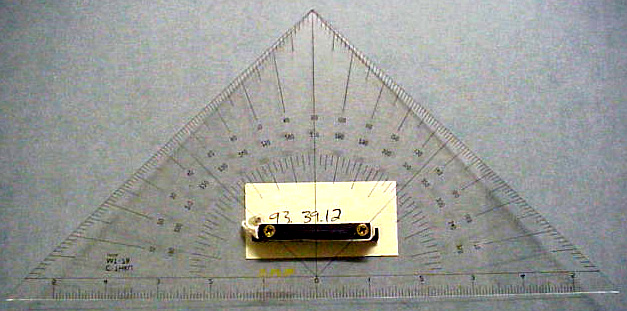
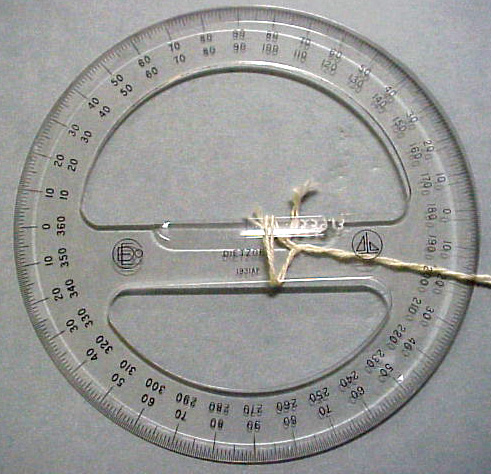
SHORT DESCRIPTION: Circular protractor, made by DIETZGEN. Graduation 0°-180° (2x) & 0°-360°, all in ½°. TIME-SPACE: 1970-1980. ADDITIONAL INFORMATION: SEE COLLECTION FILE.
A journal comprising an account of the loss of the Brig Commerce, of Hartford, (Conn.)James Riley, master : - upon the western coast of Africa, August 28th, 1815 ; also of the slavery andsufferings of the author and the rest of the crew, upon the desert of Zahara, in the years 1815,1816, 1817 ; with accounts of the manners, customs, and habits of the wandering Arabs ; also a briefhistorical and geographical view of the continent of Africa - by Archibald Robbins
8680 SONOMA MOUNTAIN ROAD - GLEN ALLEN - CALIFORNIA - UNITED STATES - Manufacturer
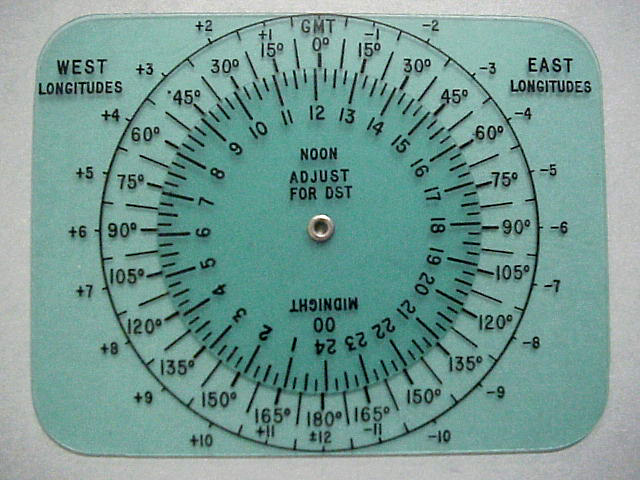
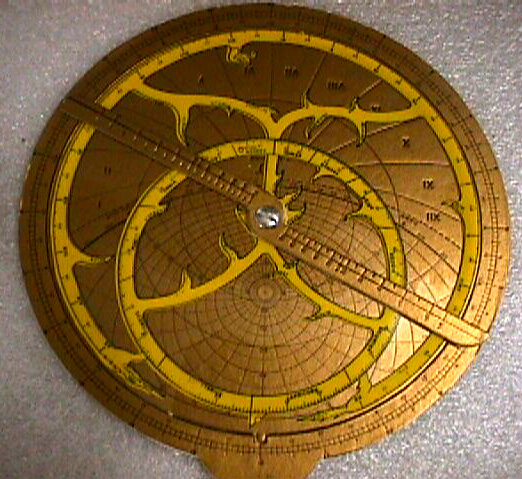
SHORT DESCRIPTION: Planispheric astrolabe, made of paper and cardboard, for educational purposes, by the GLEN ELLEN Scientific Company, Glen Ellen, California. With a set of operating instructions. NOTES: The Glen Ellen Scientific Instrument Company was operated by Albert Heppe and his wife. It sold astronomy related educational materials. The planispheric astrolabe was an astronomical instrument used for determining time, the position of stars and planets, and to measure one's latitude. TIME-SPACE: 1965-1985.
SHORT DESCRIPTION: Prismatic binoculars, make HIALEAH, no 30388,in wooden box. Magnification 7 x 50, Field 7.1°. The instrument is fitted with a compass aqua meter of Roseland, N.J. U.S.A. The instrument belonged to Lee ROBBINS (+ 1986). REMARKS: The instrument is placed in a wooden box, specially made, probably by the last owner. The box contains a screwdriver. TIME-SPACE: 1970-1985. ADDITIONAL INFORMATION: SEE COLLECTION FILE. INVENTORY: case - there is one (1) component part.
Aircraft carriers–History–20th century.; Aircraft carriers–History–20th century. Great Britain; Aircraft carriers–History–20th century. United States; Aircraft carriers–History–20th century. Japan; World War, 1939-1945–Naval operations, British.; World War, 1939-1945–Naval operations, American.; World War, 1939-1945–Naval operations, Japanese.; World War, 1914-1918–Aerial operations, British.; World War, 1914-1918–Aerial operations, American.; World War, 1914-1918–Aerial operations, Japanese.
A journal, comprising an account of the loss of the Brig Commerce, - of Hartford, (Con.)James Riley, master, upon the western coast of Africa, August 28th, 1815 : also of the slavery andsufferings of the author and the rest of the crew upon the desert of Zahara ... - By ArchibaldRobbins
Photographs of a joint interview of retired shipyard employee Gene Jaeger and Capt. Leroy F. Alexander, former Master of SS United States, as well as retired shipyard employees John R. Kane, William E. Lawson, and William S. McMahon
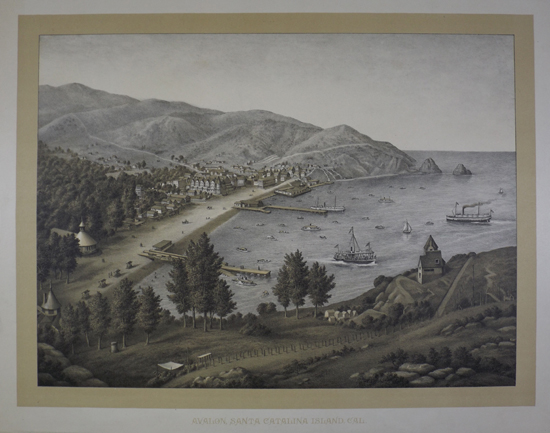
SANTA CATALINA ISLAND - AVALON - CALIFORNIA - UNITED STATES - Related Place
NOTES: Description of history associated with the same print for sale at Barry Lawrence Ruderman Antique Maps: Juan Cabrillo originally discovered and claimed Catalina Island for Spain in 1542. In 1602, Sebastian Viscaino named the island Santa Catalina. The Portola expedition also claimed the island for Spain in 1769. The Spanish began to step up their efforts to colonize California by establishing a chain of missions up and down California. Trading with foreigners was prohibited by law and Catalina Island proved a safe place for smugglers. Sea otter skins were highly sought after for the China trade and the otters were hunted to extinction in Catalina waters. In 1805 an American sea captain and trader named William Shaler beached his ship on the island for repairs and wrote that the Indians were friendly and helped him. Following Mexico's independence in 1821, Catalina and California were under Mexican jurisdiction and the secluded island continued to be a popular place to hide from the authorities. The Mission system declined and was secularized in 1834. The Mexican government gave away huge tracts of mission lands to favored individuals. In 1839, a naturalized Mexican citizen named Thomas Robbins made his first petition to Mexican governor Pio Pico to be granted the island of Santa Catalina (no mission had ever been built on the Island). Governor Pio Pico finally granted his wish on July 4, 1846, just days before the Americans went to war with Mexico. By 1848. Robbins had established a small rancho at the island's isthmus. He moved to Santa Barbara and subsequently sold the Island. Catalina changed hands many times. Following the discovery of gold in California in 1848, some minors made it to Catalina in a short-lived flurry of mining activity. Instead of gold, they found galena, an ore of silver, lead and zinc. In 1864, Union soldiers were dispatched to the Island to see if it would be suitable for a reservation for Indians from Humboldt County. All miners without substantial claims were forced to leave the island. Within a year the idea was abandoned and the soldiers left. From 1858 to 1867 a number of different people shared ownership of the island. By 1867, millionaire James Lick of San Francisco gained full ownership and evicted all the squatters from the island. When Lick died in 1876, his trustees took over the estate and in 1887 sold the island to George Shatto, a young businessman who had recently come to Los Angeles from Michigan. Shatto decided to develop the Island as a tourist resort, establishing a town in a beautiful sheltered valley with wide, crescent shaped harbor on the northeast side of the island. He enlarged the existing wharf to accommodate larger steamers, and built the Hotel Metropole. He had the town surveyed, and sold the first lots. Shatto's sister-in-law Etta Whitney chose the name Avalon for the town. Shatto proved unable to make his mortgage payments and the island reverted to the Lick Trustees. In 1892, they sold the Island to the Banning brothers. Their father Phineas Banning was a visionary who forged transportation and communication networks in Southern California. He was instrumental in the development of Los Angeles Harbor and the founder of Wilmington. His sons William, Joseph, and Hancock, assumed responsibility for many of their father's business interests. They took over the Wilmington Transportation Company in 1884, which provided more and more steamers to transport people to Catalina. Two years after purchasing the island they established the Santa Catalina Island Company and placed the land holdings that they had acquired in 1892 into the newly formed corporation. The Banning's built roads in the Island's interior, and installed the first telephone and wireless telegraph systems. They also built several tourist attractions to insure Avalon's continued success as a resort town, including two dance pavilions, a band stand, an aquarium, a Greek amphitheater, an inclined railway to take people from Avalon to Lover's Cove, and a golf course. They offered fishing excursions, sight-seeing by stagecoach, and glass bottomed boat trips. Around the turn of the century the island became world-renowned for sport fishing. Elevating fishing to a sport was a new idea, promoted in large part as a conservation effort by writer and naturalist Charles Frederick Holder, who popularized the use of light tackle. He founded the Tuna Club, which established strict rules for anglers. In 1913, Avalon became an incorporated city. In November of 1915, a devastating fire burned out of control for three days, destroying about a third of the town, including the Hotel Metropole. The Banning brothers built the elegant Hotel Saint Catherine to replace it, but were unable to recover their financial losses. In 1919, they sold the Island to William Wrigley Jr. William Wrigley Jr. bought the island sight unseen. He enlarged the fleet of cross-channel steamers, adding the S. S. Avalon, as well as the S. S. Catalina which he built specifically for the Catalina run. He constructed a power plant, improved the sewer system, and gave the island a source of fresh water by building reservoirs in the island's interior. In 1920 he built the Hotel Atwater and in 1928 built the Bird Park with thousands of exotic birds on display to the public. Wrigley also built Avalon's famous Casino, which housed a state-of-the art theatre and ballroom. At that time the word Casino was used generally to mean "a place of entertainment." At a cost of $2 million, the Casino took 14 months to build and opened in 1929. Wrigley promoted the island through well-publicized events such as the 1927 Wrigley Ocean Marathon swim and world-class golf tournaments on a renovated 18-hole course. He owned the Chicago Cubs and brought them to the island for spring training. After Wrigley's death, his son Philip continued to develop and expand Catalina. In 1975 the Wrigley donated 88% of the island to the Catalina Island Conservancy, a nonprofit corporation with a mission to "preserve and restore Catalina to its natural state in perpetuity so that future generations can continue to enjoy this unique part of California's heritage."
HARRISON - NEW JERSEY - UNITED STATES - Related Institution
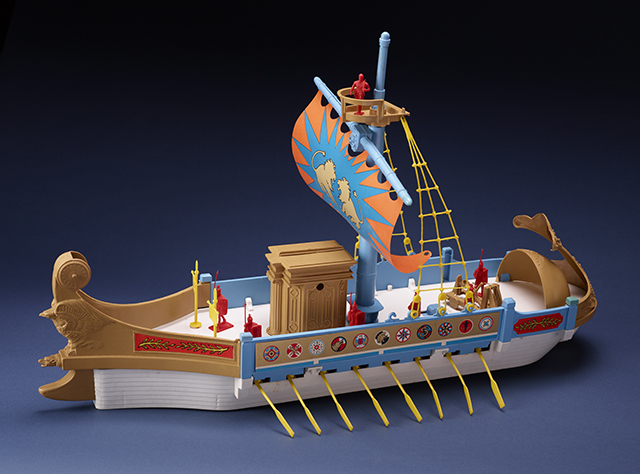
SHORT DESCRIPTION: Mechanical ship toy with troops, catapults, nets, plastic cannonballs and a cardboard fort. As it is pushed forward on its wheels, the paddles move as if the boat is being rowed. Some of the pieces are missing, but the accession does include the original box. NOTES: Includes original box, several warriors, three catapults, two chariots and cardboard fort . NOTES: Originally contained 50 troops, half of them red and half gray. Of the 50 pieces, there were 30 spearmen, 10 swordsmen, 8 archers and two captains. Accessories included a mast and sail, two yellow plastic rope nets, four catapults, plastic cannonballs and a cardboard fort. NOTES: REMCO introduced the Big Caesar Roman War Ship in 1963. REMCO was owned by Ike Heller and his cousin Saul Robbins. Heller was the son of Russian immigrants. He was drafted into the Navy during WWII and served from 1944-1946 as an enlisted radar operator and served on the USS Meredith and the USS O'Hare. During his free time he made gadgets and toys for his shipmates. Heller admitted in an interview years later that he was sea sick each and every day his ship was at sea. After his discharge he worked as a designer for a small toy manufacturer until forming his own company named REMCO, taken from the phrase "Remote Control." Heller retired from toy manufacturing in 1966 and turned to building manufactured structures that were cost effective.
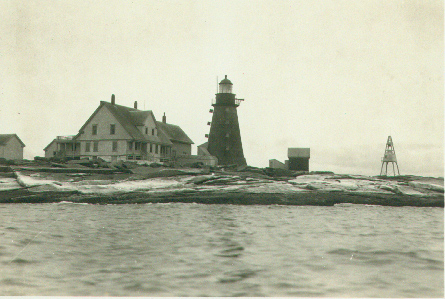
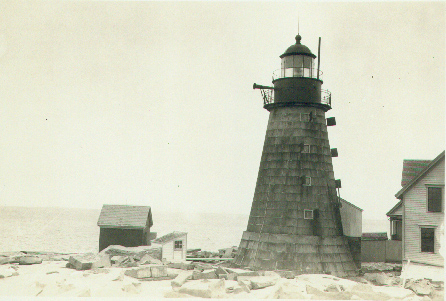
on verso: Mount Desert Lighthouse, Mount Desert Rock, ME. established 1830; 58 ft. high.
Lighthouses.
Distant view of lighthouse and keepers house with water and snow in foreground. History Mount Desert Rock is the farthest land on which a New England coast lighthouse shows its warning 'light in the window.' ...A strange sight, indeed, in a strange place! rising above the waves like the last monument of some buried city of antediluvian times... A bare rock, drenched by every gale, holds the light-tower high above the waves. Far-flung Mount Desert Rock Light is one of the most dramatically isolated of all American lighthouses. More than 20 miles from the nearest port at Mount Desert Island, the low-lying, wave swept rock is, as historian Edward Rowe Snow put it, like "part of another world." George Putnam, for many years the commissioner of the Bureau of Lighthouses, regarded Mount Desert Rock as the most exposed light station in the United States. The tiny rock is only about 17 feet above sea level at its highest point. The French explorer Samuel de Champlain, during his visit to the area in 1604, named Mount Desert Rock and the much larger Mount Desert Island. The name is traditionally pronounced "dessert," like the last course of a meal. Congress appropriated $5,000 for a lighthouse on Mount Desert Rock on March 2, 1829, to aid mariners heading to Frenchman and Blue Hill Bays from the south. The light went into operation on August 25, 1830, with a fixed white light 44 feet above mean high water. Esais Preble was the first keeper and his son, William, was his assistant. The first lighthouse took the form of a short wooden tower at one end of a stone keeper's dwelling, with a system of ten lamps fueled by whale oil. The structure weathered many storms before being replaced for $15,000 by a new 58-foot granite tower in 1847. The new tower was designed by the noted architect Alexander Parris. In 1858, a new lantern was installed along with a third-order Fresnel lens exhibiting a fixed white light. A rotating fourth-order lens replaced the third-order Fresnel lens in 1898, and the characteristic was changed from fixed to a white light flashing every 15 seconds. A second dwelling, a one-and-one-half wood-frame house, was added to the station in 1876. The old stone dwelling was replaced by a wood-frame double dwelling in 1893, providing accommodations for two keepers and their families. Several new outbuildings were added around the same time, and 250 feet of planked walkways were added between the buildings. In 1853, Albert Wood, captain of the steamer Admiral, made a case for a fog bell at Mount Desert Rock. "If a bell were ringing in thick weather," he wrote, "instead of trying to avoid the rock, navigators would calculate to go within hearing distance, get a new course, and proceed up the bay with much more safety." Other local mariners agreed, and an open-frame bell tower, with a 1500-pound fog bell operated by a striking mechanism, was installed in 1856. In 1889, the Lighthouse Board made a case for a powerful fog whistle. Congress soon appropriated $4500 and the new signal was installed. A December 1878 newspaper reported on a particularly bad storm at Mount Desert Rock: Last Tuesday night there swept along the coast of Maine... one of the severest gales that has been experienced in this latitude for years. On the shores of Mount Desert and the other islands around the mouth of the Penobscot and on the main land it was very severe, and out on Mount Desert Rock it must have been terribly wild... On Wednesday evening, the night after the storm, no light was seen in the direction of the rock. Grave fears were entertained that the lighthouse had been washed away, and that the keeper and his family had perished. Thursday and Friday nights passed, and the long-looked-for light was still missing. Then the belief became general that disaster must have befallen the light-house, and it was generally supposed that the house and its inmates had sunk beneath the waves. Owing to the roughness of the sea, there could be no communication with the rock. That Saturday night a light was finally seen and it was learned that the keeper and his family had somehow weathered the storm. In Lighthouses of New England, Edward Rowe Snow told the story of an unusual wreck in the vicinity of Mount Desert Rock in the 1880s. The schooner Helen and Mary, carrying granite from Halifax, sank in a storm near the island. The captain's wife, who was also the sister of the first mate, was on board with her baby girl. When the vessel sank the first mate was able to survive by clinging to some wreckage. As he drifted the mate saw a package floating by. He snatched it from the water and found that it was his sister's baby girl wrapped in oilskin. Air trapped inside the wrapping had kept the baby afloat. The mate held the child close to him through the night and the next day the pair was picked up by the crew of the lighthouse tender Iris. In December 1902, the New York tugboat Astral, with a barge in tow, ran aground at Mount Desert Rock in a gale with 18 men aboard. The situation looked hopeless, but with the arrival of low tide Keeper Fred Robbins and an assistant (Charles H. Newman or William H. C. Dodge) managed to get close enough to the vessel to get a line aboard. All the men except one who had already frozen to death were pulled to safety. The keeper's wife prepared steaming coffee for the survivors, and salve applied to the men's freezing limbs enabled them to recover fully. The crew of the Astral remained at Mount Desert Rock until the storm subsided six days later. Meanwhile, the barge that was being towed by the tug drifted all the way to Rockland with several men safely aboard. Despite its isolation, Mount Desert Rock was for many years a family station. It became a tradition each spring for the families to bring soil to the island for a garden, and local fishermen made contributions of earth from the mainland. By the summer a beautiful flower garden would be in bloom. With luck the flowers would remain until fall, but the first gales of winter would sweep the rock clean of the last bit of dirt. One woman who grew up on Mount Desert Rock told Mary Ellen Chase, author of The Story of Lighthouses: In recent years some vegetation has survived the mild winters at the Rock The people who sailed past called it God's Rock Garden, but it was really mine. I never gave Him my garden, but I've thanked Him all my life for Mount Desert Rock. Vinal O. Beal was one of the early 20th century keepers at the station. His daughter Robina described the unusual way her parents had of making sure she and her siblings were safe when playing outside. A line was attached to Robina's waist, with the other end looped around a clothesline that extended from the house to a derrick. This way the children could not be washed away. Arthur E. Ginn was one of the keepers for a few years around 1920. Ginn lived at the station with his wife, Inez, and their three daughters. During this time, a teacher came to the station for 10 days each month. One day, while Ginn was away getting supplies, a thick fog rolled in. According to family tradition, Ginn's daughters and the children of the other keepers sounded a fog signal (probably a backup bell) for hours so that Ginn would find his way back. He got back safely with the aid of his compass. George York was keeper from 1928 to 1936. His son Wilbur was only two years old when they moved into the station. He later remembered some details of life there helping his father polish brass and lugging coal for the stove, and the excitement of monthly runs for supplies, like 50-pound sacks of flour and 25-pound tubs of peanut butter. One year after a storm the supply boat couldn't get in and the family nearly starved, living on biscuits and molasses. Wilbur's stepmother ran out of lard for biscuits the day before the supplies finally arrived. In 1931-32, a navigational radio beacon was installed at Mount Desert Rock, and generators brought electricity to the light and keeper's house. On October 6, 1962, Hurricane Daisy struck the Rock, destroying the walkway between the house and tower, as well as sweeping away fuel tanks and other structures. The three Coast Guardsmen there at the time spent the night near the top of the lighthouse tower. One of the men, John Baxter, said later: The bad thing was that when we went in the tower you could feel the tower sway, like someone was shaking it. It was scary! The next morning, when things calmed down, we went outside the tower. We had an engine room, probably 90 feet by 90 feet. And it was gone. Crushed. A boulder had rolled up onto the bank and just crushed it. That was really scary then, because we got thinking. What if that boulder had hit that tower? It would've knocked that over, or done a good job on it. There's no way we would've survived it. In spite of the arrival of modern conveniences like television, life for Coast Guard keepers at Mount Desert Rock wasn't much easier than it had been for Lighthouse Service keepers. 20-year-old Douglas Nute, a native of St. Louis, told author Bill Caldwell that he was "ready to scream" after a week at the station. Nute had previously been stationed on Great Duck Island; there, at least, were trees and grass and some space to walk around. In the mid-1970s the Coast Guard removed the lantern of Mount Desert Rock Light to make room for rotating aerobeacons. A combination of public complaints and storm damage to the aerobeacons convinced the Coast Guard to install a new lantern in 1985. The Coast Guard crew constructed a helicopter pad in the mid-1970s. "It took one good storm to wipe it out," says Glenn Gearheart. "There was nothing like watching waves washing over the whole island. We were in the lighthouse. The whole island was vibrating." Courtesy of Glenn Gearheart The last Coast Guard keepers were removed by helicopter in late 1977. The light station was then leased to Bar Harbor's College of the Atlantic for use as a whale watching station. The college's Allied Whale program compiles and maintains catalogs for the North Atlantic populations of finback and humpback whales. More than 4,000 individual humpback whales and 500 finbacks have been cataloged by the group. Researcher Tim Cole told the Christian Science Monitor in 1988: I like to get up into the tower maybe a half-hour before sunrise. As the sky lightens, things gradually start to happen more birds fly by, or a few whales become visible. You can sit and watch as the world starts to move. The generator shed. The College of the Atlantic replaced the roof of the dwelling in 2000. A building formerly used as a generator house was turned into a marine lab. The lighthouse is best seen by private boat or from the air, although whale watches from Bar Harbor occasionally pass near Mount Desert Rock. Inside the base of the tower. August 29, 2009: According to this article, Mount Desert Rock suffered badly from the effects of Hurricane Bill. The boathouse was mostly destroyed, and two walls of the generator shed were swept away. There was also water damage inside the keeper's house. This is a major setback for the College of the Atlantic's programs on the island. As Andrew Peterson, marine facilities superintendent for the college, aptly put it, "When it comes down to it, the ocean always wins." Keepers: Esais Preble (1833-1835); Benjamin Ward Jr. (1841-?); Jacob L. Richardson (1848-1850); David King (1850-1853); Rufus King (1853-1859); George Booth (1859-1860); Joseph Hopkins (1860-1861); William E. Holden (1861-1864); Seth H. Higgins (assistant 1864-1865, principal keeper 1865-1867); J. A. Williken (1867-1868); Otis W. Kent (1868-1872); Amos B. Newman (1872-1881); James A. Morris (1881-1882); Thomas R. Milan (or Mylan) (1882-1902); Fred M. Robbins, second assistant (1898-1899), then first assistant (1899-1902) then principal keeper (1902-1911); Vinal O. Beal, second assistant (1909-1910), first assistant (1910-1911), then principal keeper (1911-c. 1918); Arthur Edward Ginn (c. 1918-early 1920s); R. W. Powers (c. 1928); George York (1928-1936); Robert G. Wass (c. 1930s); Jarvis Barnett (Coast Guard officer in charge, c. 1946-1948); Ralph Demons (or Demmons) (c. 1948-?) Assistant keepers: William Preble (1833-1835); William H. Ward (1855-1858); John Dolliver Jr. (1858-1859); B. Thurber (1859-1864); David Rollins (1865-1867); Dan Ladd (1865); William Gilley (1867); Dan B. Eaton (1867-1871); Perry W. Richardson (1868-1870 and 1871-1872); Amos B. Newman (1870-1872); Mark W. Hodgson, (1872-1882); William P. Sawyer, second assistant (1872-1878); James A. Morris (1874-1876); Frank Collins (1876-1877); Howard P. Robbins, second assistant (1878-1882); William Stanley, assistant (1882-1883); Benjamin Maddox (1883-1888); Howard M. Gilley, second assistant (1883-1887); Lewis F. Sawyer, second assistant (1887-1888), then first assistant (1888-1889); Willis Dolliver, second assistant (1887-1890), then first assistant (1890-1891); William J, Newman, second assistant (1890), then first assistant (1890); Thomas R. Savage, second assistant (1891-1892); Orrin L. Milan, second assistant (1892-1895), then first assistant (1895-1897); Charles Thurston, second assistant (1895-1897), then first assistant (1897-1899); Joseph M. Gray (1900-1901); Bert Richard (c. 1901); Herbert P. Richardson, second assistant (c. 1902); Charles H. Newman (c. 1902-1908); William H. C. Dodge, second assistant (c. 1902-1908); W. P. Kent (1909-1910); Wilbert F. Lurney (or Lurvey?) second assistant (1910), then first assistant (1911-?); Charles A. Radley, second assistant (1911-?); Joseph Muise (c. 1920s); A. H. Kennedy (c. 1932); Everett Quinn, assistant (c. 1935); H. C. Day, assistant (c. 1935); M. J. Hergatt (Coast Guard, c. 1948); H. B. Clement (Coast Guard, c. 1948); John Baxter (Coast Guard, c. 1962); Douglas Nute (Coast Guard, c. 1970s); Gary L. Crossman (Coast Guard, 1973-1974); Glenn Gearhart (Coast Guard, 1974-1975).
115 NASSAU STREET - NEW YORK - NEW YORK - UNITED STATES - Publisher
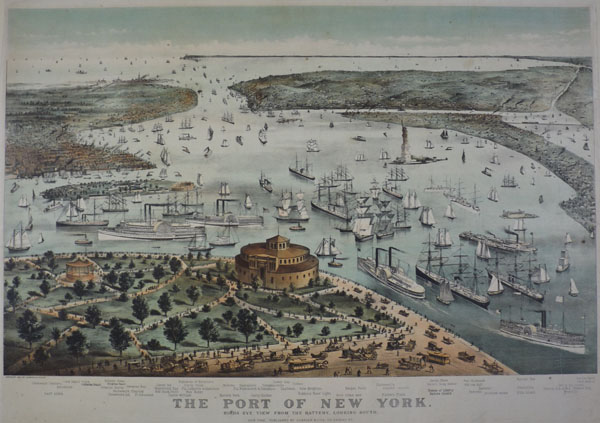
SHORT DESCRIPTION: Second state of the colored lithograph titled "The Port of New York, A Bird's Eye View from the Battery Looking South" by Nathaniel Currier and James Merritt Ives. Published in 1892. The image shows a busy view of New York harbor including the Statue of Liberty. In the foreground, a bustling Battery Park appears, surrounded by a rich tapestry of sailing ships and steamships. On the right, the map stretches out to show Brooklyn and Governor's Island, with Lower Manhattan Bay in the distance. Among the many vessel shown are four steamboats of the Fall River Line: Providence, Massachusetts, Plymouth Rock and Columbia. NOTES: A similiar lithograph (without the Statue of Liberty) was published in 1872 by Atwater & Parsons. NOTES: Reps, John William. Views and Viewmakers of Urban America: lithographs of towns and cities in the United States and Canada, notes on the artists and publishers, and a union catalog of their work: 1825-1925. Columbia: University of Missouri Press, 1984, P. 425, CATALOG 2766.
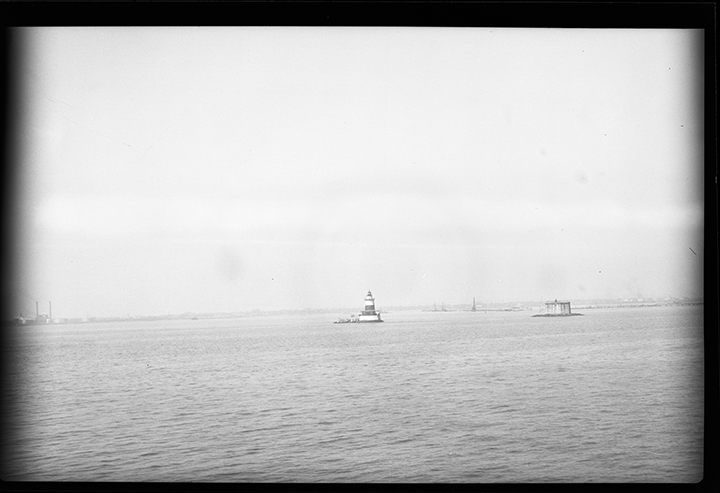
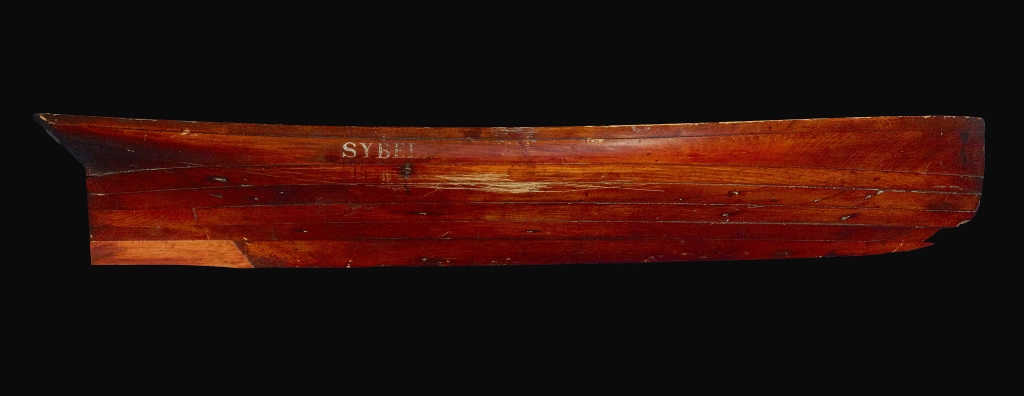
SHORT DESCRIPTION: Builder’s half hull model, starboard side, made by George Steers of the schooner Sybel. The model is a basic representation of the vessel's molded lines, without constructional details. The model is not mounted on a backing board. The model is varnished and is inscribed in whitish paint “SYBEL.” The model has a plumb stem and a raked hour-glass shaped upper stern (no counter). It has steep deadrise and little or no tumblehome. There is a curved rocker beginning 8” back from the bow (long flat keel). It has a short entry and a long run aft. The model is constructed of 7 pine lifts. The lower 5 are flat. The bottom lift (1) is 25/16” and tapers to 0” at the bow. Lift 2 is 3/8”. Lifts 3 through 5 are 7/16”. The sheer curve is cut into the 6th lift. It is 19/32” amidships, 1-1/4” at the stern, and 1-3/16” at the stem. Lift 7 tapers from bow to stern. It measures 3/8” at the bow, 11/32” amidship, and 9/32” at the stern. Lift 7 is also the top covering for the model. The dimensions of the model are 26-1/8” (length overall); 3-5/8” (main breadth), 3-1/2” (half breadth), leaving a tumblehome of just 1/8”. Height overall is 4-1/16” (at the stern). The minimum half-breadth of the model is 1/16" along the edge of the stem and at the stern. It is unclear how the lifts are held together. There are a few variously sized holes whose purpose is not apparent on the face, top and back of the model. The model is in fair overall condition. The varnish is stable. The bottom lift (1) has been repaired at the stern with a new piece of wood 4-3/8” long. The same lift has another joint near the bow but the repair looks older and may date to the model’s original manufacture. At the stern, lifts 2 and 3 also have joints that may date to the original manufacture. Lift 2 has been repaired at the bow but is still missing a large chunk at the end. There is a large area of scratches on lifts 4 and 5 just below the ship’s name. Lifts 2 and 3, and 4 and 5 are separating at the bow. The screws for the hanging hardware have split lift 6 and has caused lifts 5 and 6 to separate at the stern. NOTES: The collection of half models MR 5 through MR 24 are of vessels built by shipbuilders Henry (father), James Rich and George (sons), and Henry Steers (son of James Rich), builders of the famous yacht America. The models document vessels built between 1805 and approximately 1876. They encompass all types of vessels from a catboat up to large steam sloop built for the US Navy. In a February 13, 1963 letter Howard I. Chapelle, Curator of the Division of Transportation at the Smithsonian stated “The Steers Collection is important technically and it is something we envy the Mariners’ Museum’s possession.” VESSEL INFORMATION— VESSEL NAME: SYBEL VESSEL TYPE: Schooner yacht DESIGNER: George Steers BUILDER: George Steers BUILDER LOCATION: New York BUILD DATE: 1842 DIMENSIONS: 40 tons SHIPOWNER: C. B. Miller; R. R. Patton; E. C. Center VESSEL HISTORY: • New York Daily Herald, July 18, 1845: Sybel took part in the first regatta of the New York City Yacht Club, July 16, 1845: The 40 mile course was from a line off Robbins Reef past a mark-boat off Bay Ridge on the Brooklyn shore, then past another mark-boat off Stapleton on the Staten Island shore, thence out through the Narrows and around the Southwest Spit buoy, returning over the same course. Sybil [sic], a 42 ton schooner owned by C. B. Miller came in second, performing the distance in 5 hours, 11 minutes and 28 seconds. (came in second behind Cygnet). • New York Daily Herald, August 15, 1845: Sybil, owned by C. Miller was one of the yacht fleet to visit Newport (Annual Cruise). • Sybil [sic] also participated in what was billed the New York Yacht Clubs first annual race on July 16-18, 1846. • The season of 1847 was opened with a match race on May 25th over the regular club course for $500 a side between the schooners Sybil (still owned by C. Miller) and Cygnet. The race was won by Sybil. [Yachts and Yachting: With Over One Hundred and Ten Illustrations, By Frederic Schiller Cozzens and New York Daily Herald, May 20, 1847] • Yachts and Yachting: With Over One Hundred and Ten Illustrations, By Frederic Schiller Cozzens: On October 26, 1848 there was an experimental match that was a race that separated the boats by rig. It was over the regular club course. Sybil (37 tons) participated. The wind failed and the race was resailed on November 3rd. Only two schooners participated Sybil (owned by R. R. Patton) and Cornelia. Sybil won. • Yachts and Yachting: With Over One Hundred and Ten Illustrations, By Frederic Schiller Cozzens: The Annual Regatta was held June 5 and 7th, 1849. It was the first race that included the yachts going around the Sandy Hook lightship. The Sybil was the only second class schooner to participate and thus won the race for her class. The History of the New York Yacht Club through 1973 by John Parkinson still indicates Sybil was owned by R. R. Patton. • The History of the New York Yacht Club through 1973 by John Parkinson indicates that a Sweepstakes Race was held on October 11, 1849. The schooners Cornelia, Sybil and Twilight participated but were sailed under close reefs because of high winds. The Cornelia won because the other boats suffered gear failures. Twilight finished second under foresail alone and Sybil behind her under only a jib. • Yachts and Yachting: With Over One Hundred and Ten Illustrations, By Frederic Schiller Cozzens: Cornelia sailed in the Annual Regatta on June 3rd 1852. This was the first time the vessels were divided by tonnage and not by rig. Sybil participated as first class schooner. • New York Times, June 4, 1853: Sybil participated in the opening races of the yachting season (June 2) as a second class schooner. • Reported in May 22, 1854 New York Daily Herald: Annual Regatta of NYYC had following yachts: Cornelia, owned by Vice Commodore Edgar, 90 tons, Haze, W. H. Duncan, 110 tons, Sybil, E. C. Center, 40 tons • New York Times, June 1, 1854: Sybil participated in the annual regatta. New York Daily Herald, June 2, 1854: We were indebted to the kindness of our friend Mr. George Steers for an opportunity of witnessing the race from the time the boats started till their return. Starting from his yard, at the foot of Twelfth Street, East River, about eight o’clock, on board the yacht Sybil, in tow of a steamboat, we arrived in due time at the first stake boat, which was anchored opposite the Elysian Fields. Here we found all the yachts trying their powers previous to the race, and the steamer Josephine, which had been chartered by the members of the club for the occasion. • No records of Sybel/Sybil past 1854 could be found.
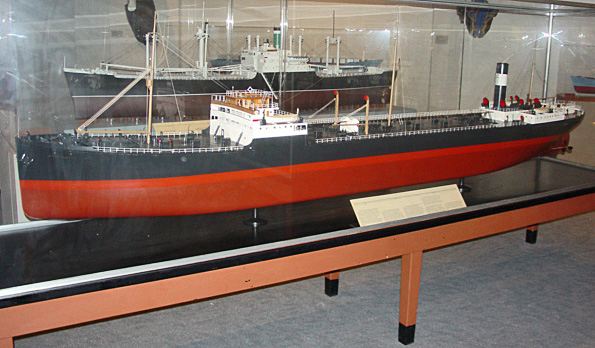
SHORT DESCRIPTION: An excellent model, with planked decks including nibbing and margin planks or pads for major fittings. Fine fittings and machinery, especially modeled individual plates on "steel" decks (the only Museum-built model to have this feature), detailed cargo piping and valves, davits, ports, boat covers, railings including gates, paneled deck houses, electro- formed cowl ventilators. NOTES: Memo in file discussing renovation done in the eighties details how this model was removed and replaced in its case. In letter dated August 31, 1938, H.L. Cornell of Standard Oil Company states that he had forwarded the smoke stack insignia which had recently been adopted and placed on all vessels of the fleet. (In case we were interested for this model) Along with this he gave a cut showing the radio direction finder installed on the ship. He also informs us that the international code signal for the JOHN D. ARCHBOLD is KDUM. NOTES: Employees from the Newport News Ship Building and Drydock Company built these models at the model shop that was once part of the Mariners' Museum. Engine: CN 169, CN 516, CN 515. There are several drawings for each of these models in the Archives of the Museum Library. David Dick, February 25, 1999 NOTES: The Wall Street Journal, October 24, 1921, page 12: In the Rockefeller and the John D. Archbold the New Jersey Company [Standard Oil Co.] has the two largest tank steamers afloat, each being 20,300 deadweight tons, with carrying capacity of 140,000 barrels of oil. They are designed particularly for moving refined oils in bulk, each being able to move about 5,000,000 gallons of gasoline or other oil products in a single cargo. VESSEL INFORMATION - VESSEL NAME: JOHN D. ARCHBOLD NATIONALITY: USA, Panamanian, British, Panamanian SHIP NUMBER: Builder's Yard No. (Hull No.) 261 VESSEL TYPE: Oil Tanker Steamship SERVICE DATES: 1921-1962 SHIP BUILDER: Newport News Shipbuilding & Dry Dock Company BUILDER LOCATION: Virginia, Newport News VESSEL HISTORY: Launched August 20, 1921. Building completed September 24, 1921. Second vessel of this name built for Standard Oil of New Jersey, and one of 41 tankers built by Newport News for this customer between 1914 and 1965. The John D. Archbold and her sister ship William Rockefeller, were the largest tankers in the world. They could carry 120,000 barrels of oil. The Archbold was named after one of the early magnates of the Standard Oil Company and was a showpiece of that firm's fleet. Survived World War II under original name; transferred to Panamanian and then British affiliates in 1949 and 1950, and sold to Panamanian owners in 1953. SHIP OWNERS: 1) Standard Oil Company Of New Jersey; 2) Panama Transport Co.; 3) Anglo American Oil Co.; 4) Steamship Enterprises Of Panama ENGINE BUILDER AND LOCATION: Newport News Shipbuilding & Dry Dock Company (Virginia, Newport News) VESSEL DIMENSIONS: 14.054 tons displacement, 20,300 deadweight tons; 570'2" x 75'1" x 42'6"" Alternate vessel names: (1) JOHN D. ARCHBOLD (1921-1950); (2) ESSO LIVERPOOL (1950-1953); (3) LIVERPOOL (1953-1962) RELATED VESSELS: sister ship WILLIAM ROCKEFELLER HOME PORT: New Jersey, Bayonne (original) PLACE OF DISPOSAL: Italy DATE OF DISPOSAL: 1963 ●Ran between New York and Los Angeles, trip takes 40 days ●Buffalo Evening News, February 10, 1922, page 17: The John D. Archobold participated in the rescue of crew from the burning U.S. Transport Northern Pacific off Cape May, New Jersey. ●The Daily Oklahoman, March 20, 1922, page 5: reported the oil tanker John D. Archbold, went aground on the west side of Ambrose channel Sunday night (March 19). ●Philadelphia Inquirer, June 30, 1922, page 23: reported the John D. Archbold went aground yesterday off Robbins Reef, floated with assistance of tubs. ●The Brooklyn Citizen, July 1, 1923, page 2: reported the tanker was aground on Bona Island, off the Gulf of Panama ●The Los Angeles Times, October 20, 1924, page 17: reported that the John D. Archbold held the world’s record for fast loading and stated “several months ago the John D. Archbold loaded into her holds over 141,000 barrels of oil, the largest cargo of bulk petroleum ever loaded on a single tanker.” The News-Pilot of San Pedro, California reported 145,000 and said it was “the largest petroleum shipment ever taken out of this port”. It also reported “on a various voyage from this port the John D. Archbold carried a load of similar size and even more remarkable was the fact that the load was pumped into the tanker in exactly six hours. Captain George Barrick had barely time to enter his ship and get his clearance papers before she was ready to sail.” ●The News-Pilot of December 29, 1924 states the record of “speedy loading” was 5 hours and 15 minutes completed by the John D. Archbold on January 28, 1924. ●The Los Angeles Times, April 8, 1925, page 17: reported: Taking off, straightening and replacing the starboard propeller [14-feet in diameter according to image caption] of the John D. Archbold, huge Standard Oil tanker, together with other things that are being done to the vessel, would take a week or more in most shipyards. But the local plant of Bethlehem Steel Corporation, if it maintains its schedule, will have the job completed at noon today, forty-five hours after it started. Nearly 2,000,000 square feet of surface were scraped and painted, the crankshaft on the starboard side was straightened, and her engines were thoroughly overhauled in that time, besides minor repairs and refurnishings. She was raised twenty-seven feet, entirely out of the water, in three hours in the Bethlehem drydock. The Archbold is the world’s largest tanker. ●Los Angeles Evening Post-Record, May 8, 1925, page 11: Break Loading Record, The Standard Oil company’s tanker John D. Archbold broke the world’s record for loading crude oil at Los Angeles harbor yesterday, when 143,290 barrels of oil were pumped in 5 hours and 41 minutes. The Los Angeles Times reported that the information was communicated by the Board of Harbor Commissioners from Traffic Manager Sandberg. ●The San Francisco Examiner, June 8, 1927, page 22: reported the collision between the John D. Archbold and the transubmarine freighter Subwarkoo [later in article spelled Sutewarkco, in another article spelled Sunewarkco] in leaving Colon on May 28. The John D. Archbold’s stern was stove in and her rudder was damaged. The Archbold went to Balboa for temporary repairs. ●The Evening Sun, Baltimore, Maryland, December 10, 1927, page 18: reports the John D. Archbold brought 8,800,000 gallons of oil to Baltimore this week. It also reports that the Charles Pratt at 14,305 tons is larger. ●The Miami Herald, July 2, 1929, page 4, quoting an article from the New York Times: Hobo Birds, Hundreds of birds beat their way North last month from the Trotugas on the John D. Archbold, a Standard Oil company tanker. The birds were not gulls as one might at once conclude. They were wrens, redwings, orioles, vireos, and other summer songsters. The person who told the story believes that the birds hailed from Yucatan but the sailors saw and heard them first when they came aboard the boat one night in the Gulf of Mexico. Wrens aplenty took possession of the crow’s nest, which does not happen to be a nest at all. Scarlet tanagers, dozens of them, were perched on the spare steering wheel. Warblers chose the funnel stays. Grosbeaks and catbirds promenaded the bridges. Bunking space on wires, rails, ventilators and the davits was fully occupied by the feathered folk. Most of the birds apparently stayed on board until the ship was off the Jersey coast, accepting bread crumbs and fresh drinking water set out by the crew. ●Burlington Daily News, April 8, 1933, page 1: Following the crash of the airship Akron the tanker John D. Archbold spotted a body floating in the water near the scene of the disaster. It turned out to be Lt. Col. A. F. Masury of the USA Ordinance Reserve who was a guest officer on board. The Archbold reported seeing the body to the USCG who picked it up with the patrol boat Galatea about 18 miles off Beach Haven, New Jersey and transported it to the Brooklyn Navy Yard. INVENTORY: screws for case - there is one (1) component part.
WILLIAMSBURG - BROOKLYN - NEW YORK - UNITED STATES - Maker
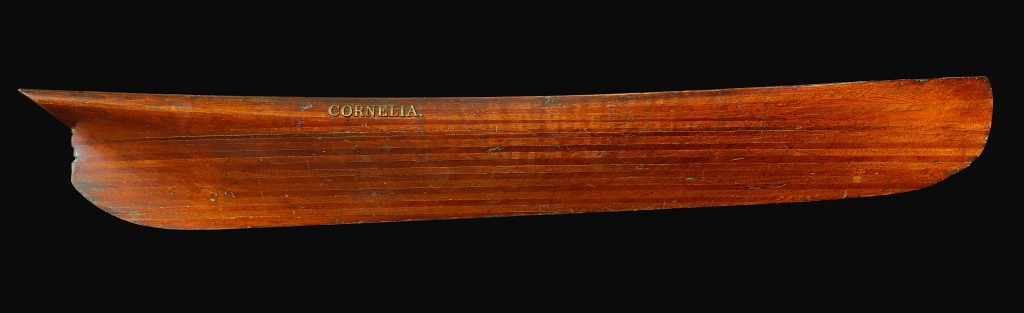
SHORT DESCRIPTION: Builder’s half hull model, starboard side, made by George Steers of the schooner yacht Cornelia. The model is a basic representation of the vessel's molded lines, without constructional details. The model is not mounted on a backing board. The model is varnished and is inscribed in black-outlined letters filled with yellowish paint “CORNELIA.” The model has a slightly curved stem and an hour-glass shaped upper stern (no counter). It has steep deadrise and little or no tumblehome. There is a curved rocker beginning 13” back from the bow. It has a short, slightly concave entry and a short run aft. The stern is not square, its rounded starting approximately 5” from the stern, leaving a short stern post just 2-1/8” high. The model is constructed of 20 lifts that appear to be various kinds of wood (there are different grain patterns visible and lift 14 looks like a hardwood like mahogany). The lower 15 are flat. The bottom lift (1) is 7/16” and tapers to zero about 12-1/4” from the bow. Lifts 2 through 12 are ¼”; lift 13 is 5/32”; lift 14 is 1/8” and lift 15 is 3/16”. The sheer curve is cut into the 16th lift. It is 3/32” amidships, 1-1/2” at the stern, and 9/16” at the stem. Lifts 17 through 20 are tapered from bow to stern. Lift 17 is 5/16” at the stem and 1/8” at the stern. Lift 18 is 5/16” at the stem and 5/32” at the stern. Lift 19 is 9/32” at the stem and 1/8” at the stern. Lift 20 is ¼” at the stem and 1/16” at the stern. Lift 20 is also the top covering for the model. The dimensions of the model are 37” (length overall); 4-11/16” (main breadth), 4-9/16” (half breadth), leaving a tumblehome of just 1/8”. Height overall is 5-3/8” (at the stern). The minimum half-breadth of the model is 1/16" along the edge of the stem and at the stern. The lifts appear to be held together with three pegs that run from top to bottom. The pegs are square/rectangular on the face of the model but round on the top. There are a few variously sized holes whose purpose is not apparent on the top and back of the model. The model is in good overall condition. The varnish is stable. Lifts 11 through 13 and 16 have some minor loses at the stern. There is a gouge about an inch from the C in the ship’s name. There are a few nicks and scattered scratches. Lift 19 has a small losses about 7” from the bow and a square section of the lift has been cut out at the stern. (1-9/16” x 1-1/2”). ADDITIONAL INFORMATION: See Yachts and Yachting with over One Hundred and Ten Illustrations, by Fred S. Cozzens and Others, 1887, image page 56, references on pages 18 and 24. VESSEL INFORMATION— VESSEL NAME: CORNELIA VESSEL TYPE: Schooner DESIGNER: George Steers BUILD DATE: 1846-1847 DIMENSIONS: 74’ length overall; 75 tons OWNER: William and Daniel Edgar CAPTAINS OR OTHER RELATED PEOPLE: George Steers (designer) SHIP OWNERS: William Edgar, New York Yacht Club VESSEL HISTORY: • On May 31st, 1847 a second match of the New York Yacht Club’s sailing season was raced over the club course and for $500 a side, between Cygnet and Cornelia, schooner of 90 tons, built the previous year for Mr. William Edgar. Cornelia took the ground off Ellis Island shortly after the start and was out of the race. [Yachts and Yachting: With Over One Hundred and Ten Illustrations, By Frederic Schiller Cozzens] • New York Daily Herald, June 3, 1847: Cornelia sailed in the New York Yacht Club’s annual regatta. o “The third boat in was the schooner Cornelia, white hull with green bottom.” • The History of the New York Yacht Club through 1973 by John Parkinson indicates that Cornelia participated in the club’s annual cruise to Newport and New Bedford. • She also sailed in the NYYC’s Second Amateur (Corinthian) Regatta on October 12, 1847. The race was sailed over the NYYC club course. The Cornelia did not finish the race, stopping some time after passing the Staten Island stakeboat. • New York Daily Herald, June 7, 1848: New York Yacht Club Annual Regatta held on June 6th, schooner first class (over 50 tons) Cornelia, 75 tons, Wm. Edgar. The Cornelia, the winning boat, was very skillfully managed by her owner William Edgar, Esq., and Commodore Thomas. She answered the helm in beautiful style, turning the stake boats, and made tracks on the homeward stretch, ploughing up the silvery wave against a hard wind, that perfectly astonished the oldest pilot on board. On beating up, she passed the Battery at the rate of 15 knots., with the sloop Maria, about a mile astern; and when passing the foot of Barclay street, the sloop Maria, in a sudden gust of wind snapped her mast; and her main sail, foresail and boom went overboard. When this accident happened, the Cornelia was about three-quarters of a mile ahead; and would, beyond a doubt, have held her own, had the Maria continued without accident. Thus the Cornelia won the race, making the forty miles, in a little over five hours, beating the Maria some forty-eight minutes…The winning boat was built by George Steers of Williamsburgh; and a beautiful model she is. • Yachts and Yachting: With Over One Hundred and Ten Illustrations, By Frederic Schiller Cozzens: On October 26, 1848 there was an experimental match that was a race that separated the boats by rig. It was over the regular club course. Cornelia participated. The wind failed and the race was resailed on November 3rd. Only two schooners participated Sybil and Cornelia. Sybil won. • Yachts and Yachting: With Over One Hundred and Ten Illustrations, By Frederic Schiller Cozzens: The Annual Regatta was held June 5 and 7th, 1849. Cornelia participated. • The History of the New York Yacht Club through 1973 by John Parkinson indicates that a Sweepstakes Race was held on October 11, 1849. The schooners Cornelia, Sybil and Twilight participated but were sailed under close reefs because of high winds. The Cornelia won because the other boats suffered gear failures. Twilight finished second under foresail alone and Sybil behind her under only a jib. • Yachts and Yachting: With Over One Hundred and Ten Illustrations, By Frederic Schiller Cozzens: October 13, 1849: Cornelia and Breeze sailed a match starting from Robbins Reef and around the Sandy Hook Lightship. Breeze withdrew when she lost her bowsprit. Cornelia sprung her mast but won the race. • The History of the New York Yacht Club through 1973 by John Parkinson indicates that Cornelia participated in the June 6 and 7, 1850 annual regatta. Cornelia was rated at 75 tons. • Baltimore Sun, May 5, 1851 reported: A race took place yesterday between the new yacht Cornelia and the pilot boat Moses H. Grinnell for a purse of $1,000. They went round the light ship and back; and the latter came in the winner. They are both schooner rigged, and nearly of the same tonnage. • Yachts and Yachting: With Over One Hundred and Ten Illustrations, By Frederic Schiller Cozzens: Cornelia sailed in the Annual Regatta on June 3rd 1852. This was the first time the vessels were divided by tonnage and not by rig. Cornelia participated as a first class schooner. • June 2-3, 1853 Cornelia (schooner, first class, over 50 tons) and Sybil (schooner, second class, over 25 tons) participated in NYYC opening season race. Cornelia completed the race in 5 hours 41 minutes and 30 seconds (28 minutes behind Una). Sybil completed the race in 5 hours 55 minutes and 10 seconds (behind Undine and Sport). • Reported in May 22, 1854 New York Daily Herald: Annual Regatta of NYYC had following yachts: Cornelia, owned by Vice Commodore Edgar, 90 tons; Haze, W. H. Duncan, 110 tons; Sybil, E. C. Center, 40 tons • New York Daily Herald, June 2, 1854: Cornelia participated in the New York Yacht Club Annual Regatta on June 1st. • Buffalo Daily Republic, August 13, 1857: In an article titled “Yachts belonging to the New York Yacht Club. William Edgar is listed as owning the Widgeon (flag ship) which means he must have sold Cornelia sometime around 1855. There is a Cornelia participating, but she’s listed as being a Boston vessel. She does not appear in the New York Marine Register of 1857. • An extensive check of the registers of New York and Boston do not turn up any vessels of comparable size. In the Times Picayune (New Orleans), October 13, 1857 there is an article stating: Southwest Pass, October 12, The pilot boat Cornelia, Capt. Chism, sixteen days from Boston via Key West, has arrived. It later reported on September 24, 1860 the pilot boat Cornelia was damaged in a hurricane. (The pilot-boat Cornelia went ashore, and was badly damaged by collision with the Galveston.) and on December 13, 1857 the Opposition Pilots, Pilotboat Cornelia No. 4, Warren Chism, James W. Lyons, Horace Sherman, William E. Pendleton, James Scott, and John L. Dows. It’s unclear if this is the schooner Cornelia built by George Steers.
 MS0091-03-01-31-086
 P0003-01 - L-6323
 L838
 93-39-01A
 Full-size image
 Full-size image
 Full-size image
 Full-size image
 Full-size image
 Full-size image
 Full-size image
 Full-size image
 Full-size image
 MS0809-03-10[1]
 KIC Image 3
 lp4357
 mt14a
 Full-size image
 Full-size image
 lp31
 2020.0014.000003_1[1]
 Full-size image
 2020.0014.000004[1]